


Confirming the Legitimacy of Parallel Imports of Genuine Goods - Analysis of Taiwan Supreme Court 2019 Taishangzi No. 397 Decision
Date: 31 July 2020
【Volume 25】
In Taiwan, the Trademark Act adopts the principle of international exhaustion. Under the forepart of Paragraph 2, Article 36 of the Taiwan Trademark Act,
When the trademark proprietor has authorized to put his products on the market anywhere in the world, he exhausts the right to control further disposition or claim trademark rights on such goods. The Taiwan Supreme Court ruled firmly on the legitimacy of parallel importation of genuine goods in 2019.
Case Fact
Jeela's Boutique, which is the plaintiff and the appellant of this case, has ordered products under a US trademark “PHILIP B”, which was registered by PHILIPSCOTT, INC. (CALIFORNIA CORPORATION), DBA PHILIPB, INC. (hereinafter referred to as “PHILIPSCOTT”), on PHILIPSCOTT’s official website in the USA since 7 January, 2016. Jeela’s then sold the goods as the “parallel imports of the genuine goods” in the Taiwanese domestic market.
Ohwin Inc., which is the agent of PHILIPSCOTT in Taiwan, exercised its trademark right on the registered trademark “PHILIP B” in Taiwan against Jeela’s several times. Accordingly, Jeela’s filed a civil action before Taiwan Intellectual Property Court to declare that Ohwin could not claim the trademark right against Jeela’s.
The court of first instance and second instance at the Taiwan Intellectual Property Court both held that Ohwin was entitled to claim the trademark right against Jeela’s, and ruled the decision against Jeela’s. However, the Taiwan Supreme Court reversed the original judgement, holding that the Intellectual Property Court has wrongly construed “the principle of international exhaustion”.
Taiwan Supreme Court’s Opinion
- The principle of territoriality implies that when a trademark is recognized as having a separate right in each sovereign territory in which it is registered. The Supreme Court found that, if the trademark specimen in different countries is identical, the exclusive right should originate from the same person in essence. As long as the trademark proprietor in different countries is authorized by or has legal relationship with the original brand owner, the trademark proprietor’s right against the parallel importer is also exhausted.
- The issue presented was after the goods have been put on the market by the US brand owner PHILIPSCOTT, if there are no legitimate reasons for claiming trademark rights, does Ohwin, who is entitled to the “PHILIP B” trademark right by PHILIPSCOTT’s consent, also exhaust its rights on the goods bearing “PHILIP B”? The Supreme Court reversed the Intellectual Property Court judgement, reasoning that the court of first instance and second instance both did not consider the above issue but directly held that Ohwin did not receive the remuneration when the goods was first sold in the market, and ruled that the principle of exhaustion is only applicable when the domestic and foreign proprietors are the same person. The Supreme Court concluded the original decision against Jeela's was not correct.
Wisdom Commentary
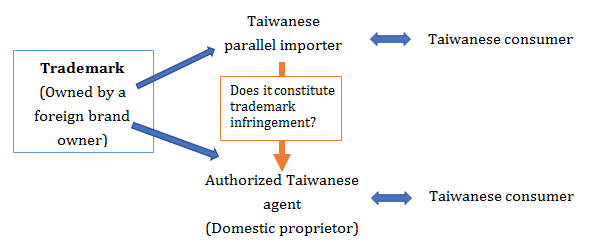
The question before the Taiwan Intellectual Property Court was whether Paragraph 2, Article 36 of the Taiwan Trademark Act (i.e. the principle of international exhaustion) is applicable when the two conditions “parallel imports of genuine goods” and “the trademark right across the world belongs to different entities” exist. In the past, the Taiwan Intellectual Property Court considered the foreign proprietor is “the person who puts the goods on the market”, not the domestic proprietor. Therefore, only the foreign proprietor’s rights are exhausted, and the domestic proprietor is still entitled to claim his trademark rights against the parallel importer.
In this decision, the Taiwan Supreme Court corrected the Taiwan Intellectual Property Court’s ruling. The Supreme Court clarified that the condition for applying Paragraph 2, Article 36 of the Taiwan Trademark Act is where the exclusive trademark right essentially originates from the same person. From this perspective, not only does the foreign proprietor exhaust his right, but also the authorized domestic proprietor. That is, Jeela's can claim the parallel imports of genuine goods against Ohwin.
Though the above opinion is mostly construed as favoring the parallel importers and largely against the authorized agent (or authorized domestic proprietor) of the foreign brand, the agent still can claim its right against the importer when the importer mislabels or advertises himself as an authorized agent according to the Taiwan Trademark Act. In previous decisions, the Taiwan Supreme Court also held that the owner’s trademark rights are infringed if the parallel importer does not sell the goods in their original forms, but processes, remodels or modifies the goods without authorization. Furthermore, if the trademark is used on the importer’s commodities or advertisements in a way which leads to confusion, making the consumers misunderstand that the importer is the trademark proprietor or the authorized, appointed agent, the trademark is also infringed. The authorized domestic proprietor is then entitled to claim the trademark rights against the importer.
In addition, if the importer passes the fakes off as the parallel imports of genuine goods, according to the Taiwan Fair Trade Act, the domestic proprietor or authorized agent can send a warning letter to inquire the origin of the goods. Once there is substantial evidence proving the goods are counterfeits, the proprietor can also claim his rights under the Taiwan Trademark Act.